• A weekly journal urging a rekindled love-affair with the ever giving abundance found in our woodlands, deserts, prairies, parks, peaks and backyards. Please see a more full statement of my intent HERE

Unseen Hand Of Water

I don’t intend to focus much on my own work in this journal but there are some pieces which resonate so strongly with my intent here that I will occasionally insert them.

My aim with this work was to evoke the mystery around a narrative that has already passed.

I had begun the carving before the tragic events in Tohoku, Japan, March 2011, and I was certainly struck with how water can reshape our lives as well as create tranquil beauty. I had many moments while making it to reflect on the quiet endurance of the Japanese people in the wake of the destructive Tsunami.

During many quiet and restorative hours in Nature, I am fascinated with the ever-changing details of stream beds after high-water events such as spring run-off or a large rainfall. One of the phenomena that appeals to me in this regard is the patterns left by the water in sand-bars, and in the reshaping of sand-bars. Objects large and small, such as logs, stones and twigs come to rest in the sand, creating a small still-life, charged with the power of the water and the mystery of how objects came to their position.

A stream-bed focuses several powerful visual and dynamic realities. In the short term, every visit unveils new courses of water, and new arrangements of sticks, stones, leavings and bits. In the longer run, the work of water for ages reveals rocks uplifted when North America and Africa were one continent. I find it impossible to be emotionally unaffected by this display of transformation and beauty, both short and long-term. I hope the evocation of this work will involve the viewer with their own imaginative emotional response.

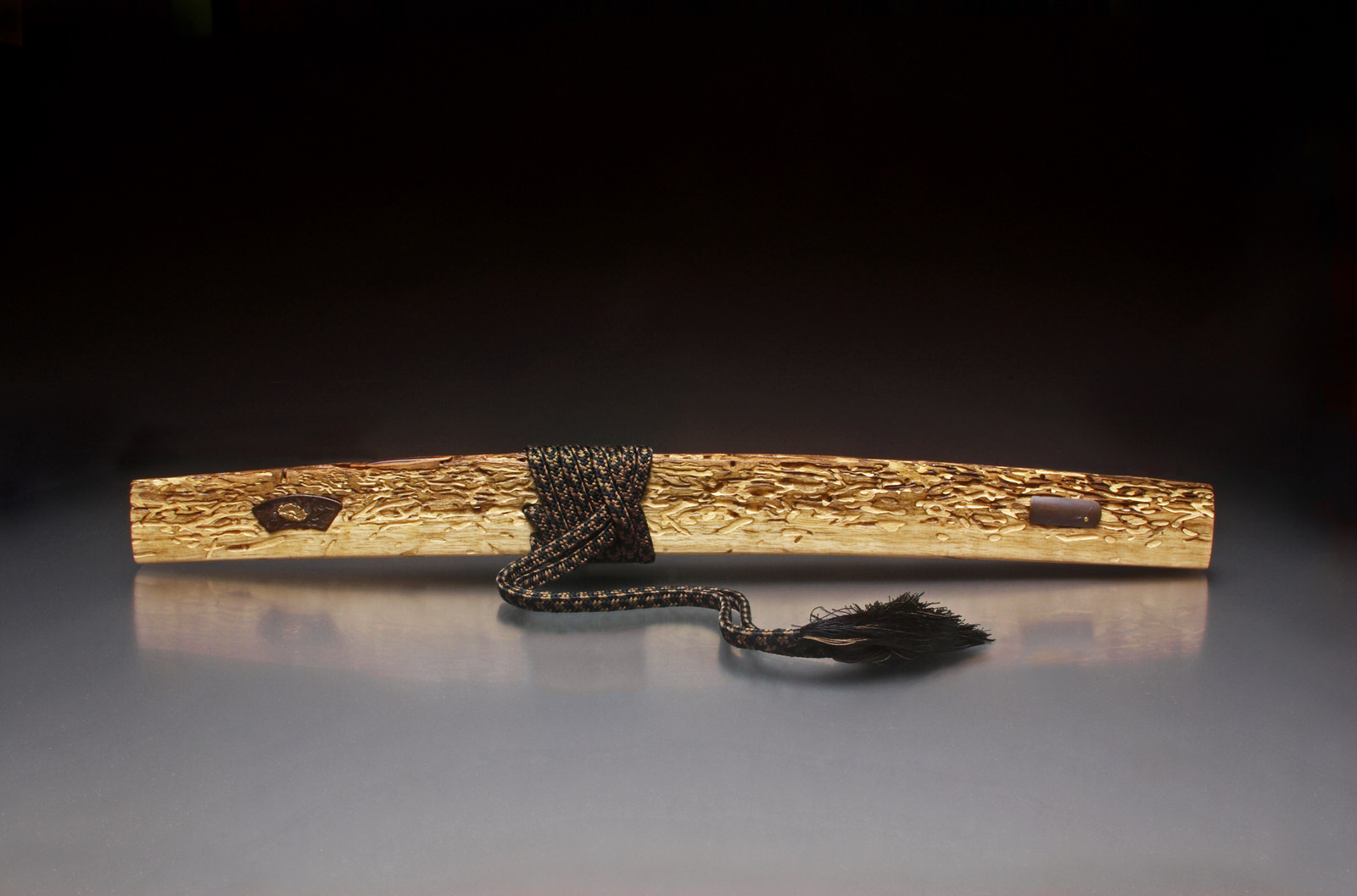
I carved an undulating surface in the wood representing the sand patterns, and textured the surface to appear as sand. This texture was done with a triangular chisel point, moved in various angles so that the reflected light would dance as grains of sand might in the light.

The stones are made from, iron, lead, two alloys of shibuichi and pure silver. The twig is made from shakudo with traces of gold.


Toward The New

Perhaps 2011 could have been kinder to us, but hopefully we’ll continue to count Blessings. The Golden Rule remains as the touchstone for human “progress”.

Even the Wild Turkey leaves an unselfconscious angelic print as it lifts to the future.


Happy New Year!


Frozen Genius

“How full of the creative genius is the air in which these are generated! I should hardly admire them more if real stars fell and lodged on my coat.”   H.D. Thoreau, Journal, 1856

I don’t know if in those days astronomers knew that every bit of Earth was once part of a star.

Being a fiend for snow, snowstorms and other frozen phenomenon, it is a sad winter to have so little happening here yet this season. It drives me crazy to hear significant events described solely on a relative scale of disaster, seemingly only related to our ability to motor around or not. Some shots below from years past.

Thanks to   SnowCrystals.com   for the snowflake photo and the quote. Please visit their website for a treat.


Metallic Animus

In June I was very fortunate to travel to Japan. My host and good friend Murata-san has a fantastic collection of Edo and Meiji period metalwork housed at the Kiyomizu-Sannenzaka Museum in Kyoto. KIYOMIZU-SANNENZAKA MUSEUM

Murata-san is always very kind and generous in making pieces available for me to examine in hand and to photograph. It is an amazing opportunity as they are among the finest in the world of this type of work. Some pieces have only been in private collections and have never been published or viewed publicly.

I would like to share some of these works and Murata-san has kindly agreed. The first is a tsuba(sword guard) by Shoami Katsuyoshi (1832-1908). For those not familiar with Japanese metalwork or sword fittings(kodogu) a little background may be necessary. Many will know how highly the sword was (is?) esteemed in Japanese culture. It is, no doubt, less well known that the various kodogu, especially tsuba, were also highly valued and often made as stand-alone art objects that, while technically functional, were probably never destined to be mounted on a sword.

Another historical consideration around the story of Shoami Katsuyoshi is that his career as a maker of sword fittings was interrupted dramatically by the Haitorei edict of 1876 limiting the carrying of swords. The subsequent demolition of demand for kodogu can hardly be overstated. Some older craftsmen/artists such as Goto Ichijo were so devastated by this that they could hardly continue. Goto Ichijo was the master heir of 14 generations (400 years) of uninterrupted superb metal craft in the Goto line. He had supplied sword mountings to the Emperor and Shogun but was reduced at the end of his career to what he described as a “hand-to-mouth” existence.

The connoisseurship for kodogu continued somewhat after the Haitorei edict and some younger exceptional craftsmen such as Katsuyoshi were able to adjust and adapted to making artistic fittings as well as vases and sculpture for a growing European market, fueled by the extravagant international exhibitions of the day, such as London 1862 and Philadelphia 1876 which opened the world’s eyes to Japanese art.

This tsuba is made primarily of the Japanese alloy shakudo, with inlays of shibuichi, copper, silver and gold. The subject is a crane and reeds. The beautiful inlaid sosho( grass script) poem is from Lady Ise and refers to a crane crying in winter reeds. For more information on Japanese alloys please go:  HERE

Some tsuba collectors object to the sumptuous nature of such works as this, but as a metal engraver, I am in awe of the skill, artistry and sensitivity needed to produce such an object.

Acknowledgements to the Kiyomizu-Sannenzaka Museum for allowing me to photograph this tsuba and to Hiruta Michiko for biographical information on Goto Ichijo.

Shoami Crane/reeds


Shoami close 2


close


No Till, No Plant, No Weed

What a great wild berry year. Here is the Faery Harvestress (don’t overlook the White Birch tiara), with sprigs of High-bush Cranberry, Elderberry and some Matsutake thrown in for good measure.

The search for wild comestibles yields rewards beyond the edibles. Just being out there leads the list. Learning the identification and habitat of the prey leads to all sorts of discoveries related to said habitat such as how other plants figure into that particular mini ecosystem.

Also, once one becomes familiar with the habit and appearance of a plant you begin to look less intently, and then to notice them naturally as they almost jump out at you, and how they look in different seasons.

“You can observe a lot by watching”  Yogi Berra

The harvest is rich of course in so many inestimable ways by merely being and absorbing.